
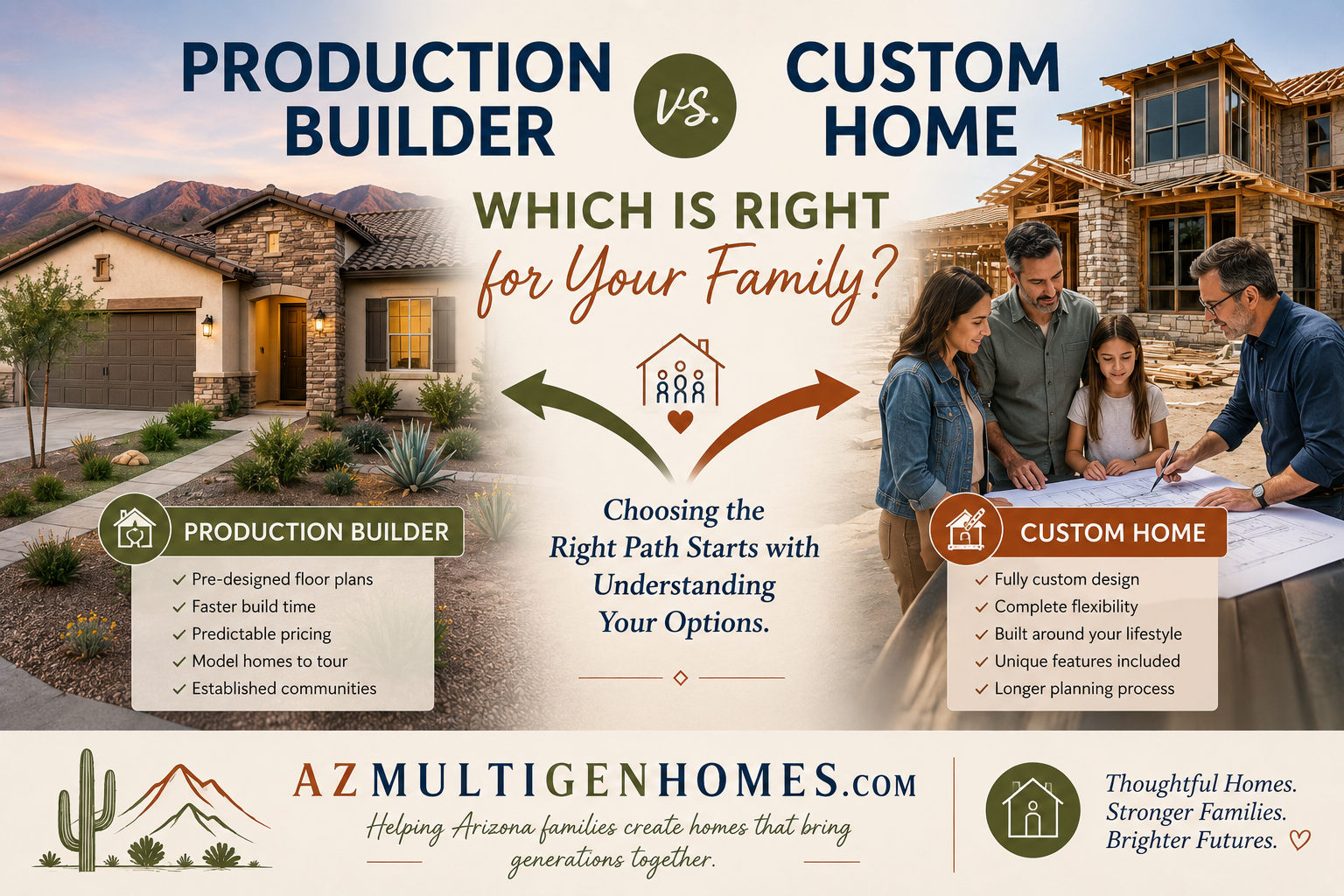
 Understanding your options before building your multigenerational home.
Should you choose a production builder or build a custom home? Learn the differences, advantages, costs, and considerations for creating the right multigenerational home in Arizona.
For many families, there comes a point when finding the perfect multigenerational home means asking an exciting question:
Should we build instead of buy?
Building a home gives you the opportunity to create spaces that fit your family’s unique needs, from private guest suites to flexible living areas and accessible design features.
But before choosing a floor plan, there’s an important decision to make:
Should you work with a production builder or build a custom home?
Both approaches offer advantages, and understanding the differences can help you choose the option that’s right for your family’s lifestyle, budget, and long-term goals.
What Is a Production Builder?
Production builders construct homes using a collection of pre-designed floor plans within planned communities.
You’ll typically choose from several home designs and personalize your home by selecting finishes, colors, cabinetry, flooring, countertops, and other available options.
Many of today’s production builders also offer thoughtfully designed multigenerational floor plans with features such as:
- Private guest suites
- Separate entrances
- Dual primary suites
- Flexible living spaces
- Casita-style layouts
- RV garage options in select communities
Builders such as Lennar, Shea Homes, Taylor Morrison, Toll Brothers, and others each take a different approach to serving multigenerational families.
Advantages of a Production Builder
Production builders can offer several important benefits.
Predictable Pricing
Because floor plans and construction methods are standardized, pricing is often easier to understand than a fully custom project.
Faster Construction
Production builders typically have established construction schedules, allowing many homes to be completed more quickly than custom homes.
Model Homes
One of the biggest advantages is the ability to walk through furnished model homes.
Seeing the space in person helps families understand how a floor plan feels and functions before making a decision.
Established Communities
Production homes are often located in master-planned communities offering parks, walking trails, community amenities, and neighborhood consistency.
Things to Consider
Production builders also work within established design guidelines.
While many customization options are available, significant structural changes may be limited.
If your family has highly specialized needs, you may discover that even an excellent floor plan still requires compromise.
What Is a Custom Home?
A custom home is designed specifically for you.
Rather than choosing from existing floor plans, you work with an architect and builder to create a home that reflects your family’s unique vision.
Everything—from room placement to window locations—is planned around the way your family lives.
Advantages of Building Custom
One of the greatest benefits is flexibility.
You decide what matters most.
Perhaps your family wants:
- A fully independent suite for aging parents.
- An attached casita.
- A large shared kitchen.
- Dual laundry rooms.
- A hobby workshop.
- A home office with a separate entrance.
- Universal Design features incorporated from the beginning.
Custom construction allows these ideas to become part of the original design instead of adaptations later.
Things to Consider
Custom homes generally require:
- Longer planning timelines
- Architectural design
- More decisions throughout construction
- Greater budget flexibility
- Finding and purchasing an appropriate lot
For families who enjoy the design process, this can be an exciting opportunity.
For others, the number of decisions can feel overwhelming.
Which Option Is More Affordable?
There isn’t a universal answer.
Production builders often benefit from economies of scale, making many homes more affordable on a price-per-square-foot basis.
Custom homes, however, allow you to invest your budget in the features that matter most to your family rather than paying for upgrades you may never use.
When comparing costs, remember to consider the complete project, including:
- Lot costs
- Site preparation
- Landscaping
- Window coverings
- Appliances
- Builder upgrades
- Utility connections
- HOA fees (where applicable)
The lowest advertised base price rarely reflects the final investment.
Which Is Better for Multigenerational Living?
The answer depends on your family’s priorities.
A production builder may be an excellent choice if:
- You appreciate established neighborhoods.
- A thoughtfully designed floor plan already meets your needs.
- You prefer a simpler building process.
- Predictable pricing is important.
A custom home may be the better fit if:
- Your family has unique accessibility requirements.
- You want complete flexibility in the design.
- You already own land.
- You have a very specific long-term vision.
Neither option is inherently better.
The best choice is the one that supports your family’s goals.
Questions to Ask Before Deciding
Before choosing either path, consider discussing these questions together:
- What level of privacy does each generation need?
- How important is future flexibility?
- Do we need accessibility features today—or should we prepare for tomorrow?
- How involved do we want to be in the design process?
- What budget are we comfortable investing?
- Would remodeling our current home accomplish the same goals?
Taking time to answer these questions often makes the decision much clearer.
Final Thoughts
Building a multigenerational home is about far more than choosing finishes or selecting a floor plan.
It’s about creating a place where your family can live well together for years to come.
Whether you choose a production builder or design a custom home from the ground up, the most successful projects begin with thoughtful planning and a clear understanding of your family’s priorities.
There isn’t one perfect way to build.
There is only the approach that’s right for your family.
To research even more about creating your best multigenerational home check out these resources:
Designing & Building Your Multigenerational Home
Universal Design: Building a Home That Works for Every Stage of Life
10 Features Families Often Forget When Choosing a Multigenerational Home
Should We Remodel Our Home or Move?
Lennar Next Gen®: A Buyer’s Guide
Not All Multigenerational Homes Are Designed the Same
Explore Multigenerational Floor Plans
Thinking About Building a Multigenerational Home?
Whether you’re comparing builders, exploring custom home possibilities, or deciding whether building is the right choice at all, I’d be happy to help you evaluate your options.
Together, we can find—or create—a home that supports your family’s future for generations to come.
Kristin Geesey, REALTOR®, CLHMS®, SRES®, GRI, Multigenerational Home and Living Specialist
719-573-9657
info@azmultigenhomes.com
Helping Arizona families create homes that bring generations together.